A snapshot instead of a trend.In-house psychologists: expensive & limited capacity.HR software: cumbersome & barely any strategic value.
An active early-warning systeminstead ofan annual box-ticking exercise.
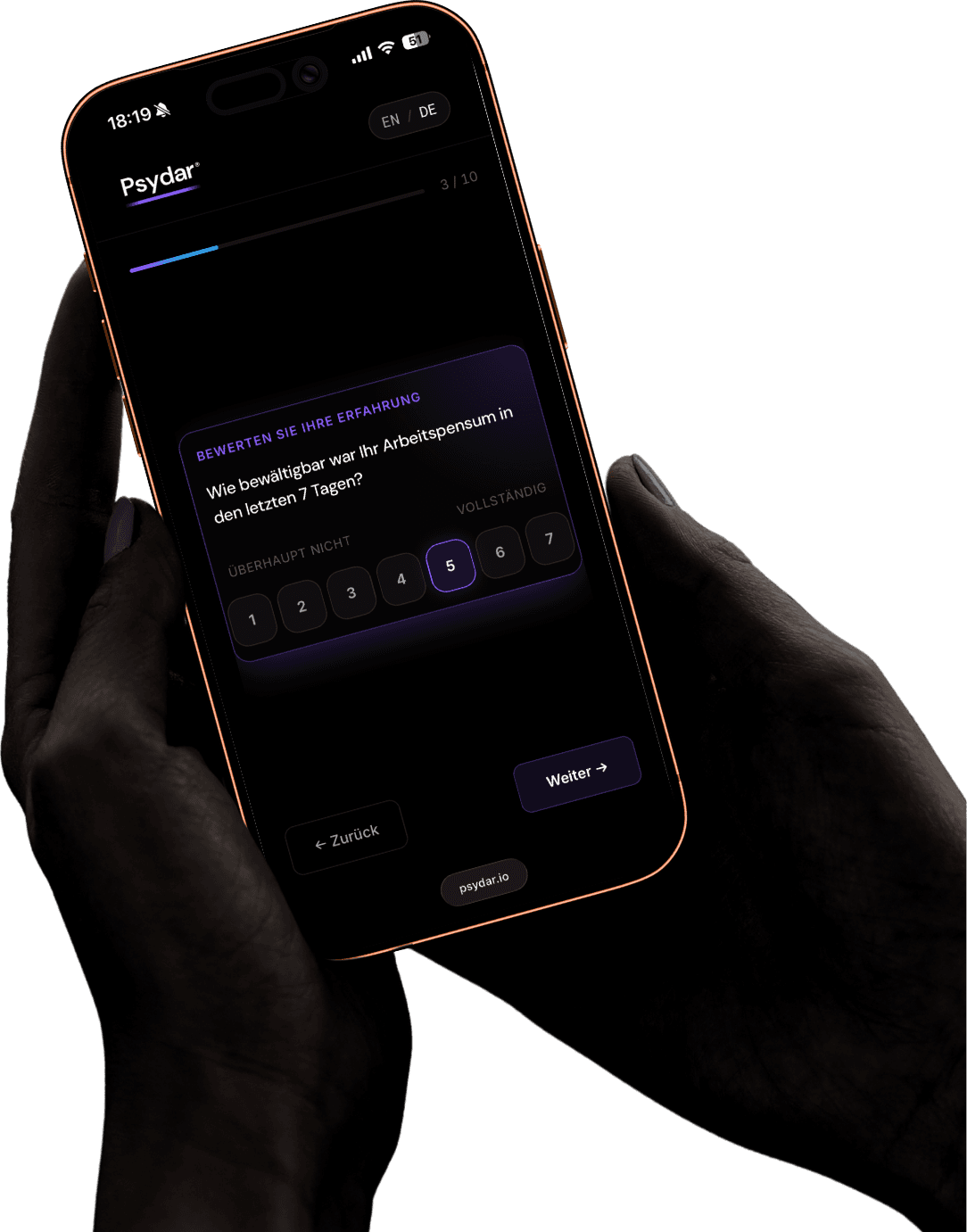
Psydar picks exactly the right ones from over 10,000 formulable questions — 5 to 10 per week.
It asks where the information gain is greatest. Every answer shapes the next one.
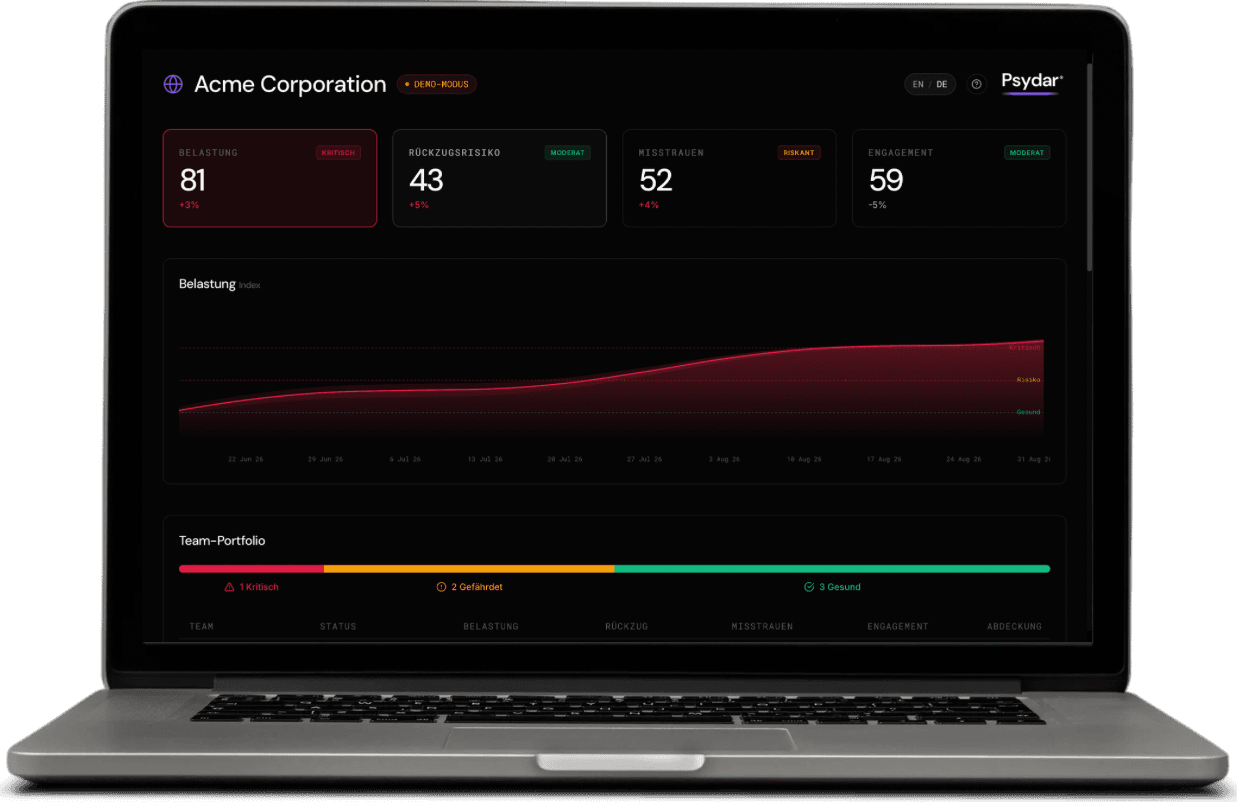
Warning signal & action
Shows which teams are at risk.
Explains why exactly.
And derives concrete recommendations from it.
You spot problems
while you can still act.
Every answer updates a per-person statistical estimate of 14 psychological constructs, weighted by how certain each measurement is. Out of that come four indices — each with its own margin of error, not an average.
The measurement and the analysis are arithmetic: the same data always yields the same result, and every step can be traced. A language model only phrases the write-up, and there is a deterministic version of that too.
Built on established methods from work and organisational psychology and benchmarked against standard instruments. A pilot study with an industry partner starts in October 2026, with academic oversight.
HR software gives you an annual survey without causes. An in-house psychologist covers one team at a time. Psydar does both — continuously, for every team.




What sets us apart.
Radically simple to use despite its algorithmic-psychological depth. Psydar skips information-free cosmetics: every number on the screen means something.
The system remembers what it already knows about each person and only asks what it doesn't know yet. That keeps the questions short and the answers honest.
Most tools need a consulting team for every survey round. Psydar keeps running on its own once it is set up — week after week, without outside help.
Recommendations emerge from a theory-driven model of how drivers and indices depend on each other, mirroring the way an organisational psychologist works.